

Here are the books I’ve read this year, plus a few essays I’ve loved along the way. You must know that I put books down constantly, so almost everything on this list (with a couple of exceptions) gave me something worth keeping.
I tried to keep reviews as short as possible, alas, I’m not great at doing so! In any case, I’m hoping you find something of interest here.
A few themes emerged as I compiled this list, however, these are very loose categories. Many books belong to more than one.

🌀 The Terrors and Powers of Having a Body
How bodies, especially women’s bodies, are observed, treated and archived by external systems of representation that end up controlling them. Many of these books remind me that if a body is a site of control it can also be a site of resistance. Some of these writers ask what remains of the self once identity is filtered through data and image, misogyny and race, gender and sexuality.
“Gender has been used as a weapon against its own populace. The idea of 'body' carries this weapon: gender circumscribes the body, 'protects' it from becoming limitless, from claiming the infinite vast, from realising its true potential.” Legacy Russell, Glitch Feminism
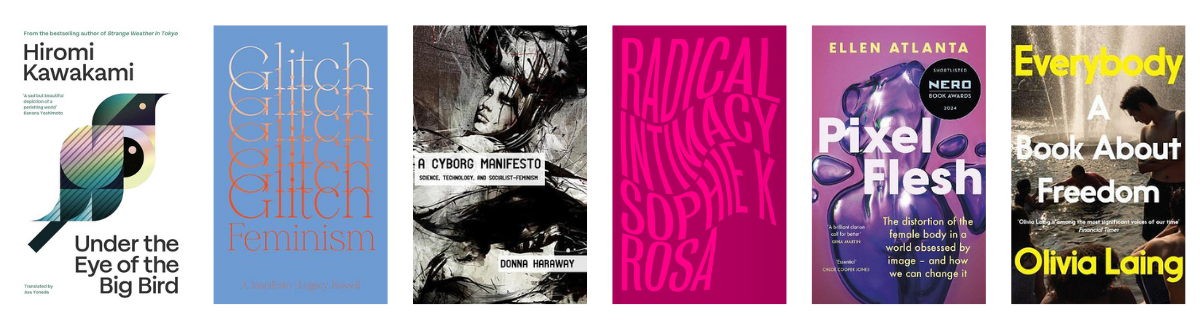
After deciding to read more speculative fiction last year, I decided to finally read Kawakami, who had been on my radar for years. Under the Eye is set in a post-apocalyptic future where humans are facing extinction and all sorts of efforts are made in order to prevent this from happening. This read like a collection of short stories rather than a novel and I’m not sure I loved it. Kawakami holds back a lot, offering the reader very little to work with which left ambitious themes (human connection, human purpose, and the meaning of life), feeling only vaguely explored in my opinion.
Similar themes, better loved: Parable of the Sower by Octavia Butler. A more grounded, character-driven take on human survival and purpose at the edge of extinction.
At the start of the year I found myself absorbed by cyberfeminism, which I'd known very little about. After listening to an interview with Mindy Seu, I picked up Glitch Feminism. Russell reframes the “glitch” (a break or error in a digital system) as a site of resistance to the binary logics of gender and embodiment, arguing that digital space, rather than being purely alienating, can offer room to construct identities that escape the constraints of the physical, AFK ("away from keyboard") world. It begs the question: who gets to comfortably and safely go fully offline?
What I’ve added to my list since reading: Russel references Cruising Utopia: The Then and There of Queer Futurity by José Esteban Muñoz which I plan to read at some point this year.
Algorithms of Oppression by Safiya Noble, exploring the bias of the internet, who digital systems actually serve, and how, as the title suggests, search engines reinforce racism.
As I started learning about cyberfeminism it seemed imperative I read Cyborg Manifesto, considered by many a foundational text of the movement. Haraway proposes that the cyborg — a figure that refuses clean boundaries between human, animal and machine — is inherently a feminist political proposition, since it can’t be neatly categorised and therefore destabilises the systems that depend on clean categories to function. For all its radicalism, Haraway fails to address race at all, making this a very white, middle-class vision of liberation that doesn't hold up once the body in question has already been marked by race and class. This was also a very dense read.
This led me to the following essay by Faith Wilding.
[essay] Where is the Feminism in Cyberfeminism by Faith Wilding / February
In her 1998 essay, artist and theorist Faith Wilding critiques cyberfeminism at length, claiming that the movement failed to interrogate the biases entrenched in cyberspace. If you’ve read or plan to read Cyborg Manifesto, I suggest reading this essay alongside it. We won’t get anywhere if our feminism isn’t ALWAYS intersectional.
As I was doing my Masters in Counselling I grew increasingly dissatisfied with a curriculum totally devoid of politics. I decided to bridge that gap by building my own reading list that recognised how mental health is inextricably linked with politics; you really can’t discuss one without the other!! Rosa critiques the narrow, capitalism-shaped range of relationships we consider legitimate, calling for closeness beyond the couple form toward more collective care. Short, punchy, and well researched this is a good reminder of the many ways we can build community outside monogamous relationships and the nuclear family.
Other books I added to my curriculum: The Burnout Society by Byung-Chul Han (read, great!), Capitalist Realism by Mark Fisher, Mad World: The Politics of Mental Health by Micha Frazer-Carroll, Capitalism and Desire by Todd McGowan
Reading Every Body after reading Russell, Haraway and Lispector, made for a such a magnetic and memorable experience. Laing frames the body as a site of pleasure and pain, oppression and power, using Wilhelm Reich as the central figure tying the essays together. Reich, in striving to free people from the constrictive knots of authoritarianism, couldn’t help getting caught in them himself. It is through this lens that Laing writes about Sontag, Dworkin, Agnes Martin, Nina Simone, among others, to show the contradictions that come with wanting to free the body from fear and prejudice. My copy is full of post-it notes. Favourite Laing book so far.
Other books I’ve enjoyed from Laing: The Lonely City and Funny Weather.
In all honesty, I picked this book due to it’s cover, having heard nothing about it beforehand. Atlanta explores how algorithmic beauty standards and social media exacerbate the pressures women feel around their bodies. I happened to be writing a video essay on body discipline at the time, drawing heavily on Foucault’s work on docile bodies and surveillance, which Atlanta also references. I’d say it’s a very accessible read, weaving personal experience, interviews, feminist theory and scientific research together. I didn’t find it especially groundbreaking, but every now and then it’s worth being reminded of what you already know, and this did that.